

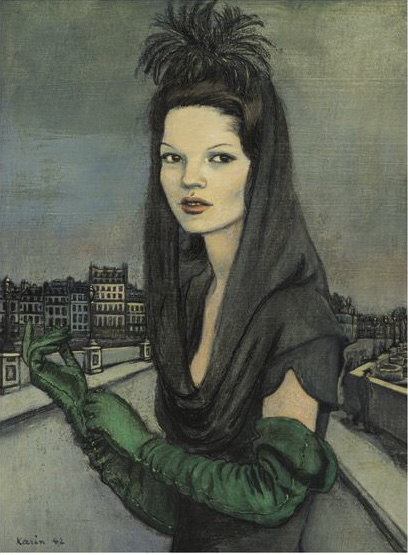
Some paintings arrive at The Bennett Collection framed, cleaned, and ready for the wall. Others arrive the way Gants Verts sur le Pont Neuf did: rolled in brown paper that had gone brittle with age, smelling unmistakably of the attic it had spent the better part of a lifetime in. Dust, old varnish, decades of sealed-off air — it is, if you have spent any time around old paintings, an instantly recognizable smell, and it is usually the first sign that something worth saving has been waiting quietly to be found.
We love this kind of acquisition precisely because it isn't a straight line. A painting that has been stored away rather than exhibited carries a different kind of history than one that has hung in galleries its whole life — a history of being set aside, forgotten, and then, eventually, rediscovered. Gants Verts sur le Pont Neuf had clearly been through exactly that. The surface had darkened under a heavy skin of old varnish, and the canvas needed careful attention before the painting underneath could be seen clearly again. Once it was cleaned, what emerged was unmistakably Karin van Leyden — a woman on the Pont Neuf in a pair of vivid green gloves, rendered with the same confident, worldly hand that made her one of the more fascinating figures of her generation.
Van Leyden's life reads like something out of a novel. Born Elisabeth Kluth in Charlottenburg, Germany, in 1906, she began her studies at the Cologne Art School under Johan Thorn Prikker and Richard Seewald before continuing her training in Switzerland — where she met her husband, the Dutch painter Ernst van Leyden. The two of them traveled through Egypt, Syria, Italy, and Lebanon before settling into the Parisian café society of the late 1920s and 1930s, a circle that included Marc Chagall, Willem de Kooning, and Piet Mondrian. It is easy to imagine Gants Verts sur le Pont Neuf coming out of exactly that period — a woman of the city, painted by a woman who was very much of that world herself, on one of the most storied bridges in Paris.
Sensing the gathering political storm in Europe, van Leyden and her husband eventually left for California, where she expanded into murals, commissioned advertising work, and painted glass, before turning to abstraction later in life. It is the earlier, worldlier van Leyden — the painter of Paris, of society portraits, of a life lived between continents — that Gants Verts sur le Pont Neuf captures, and that makes its condition on arrival so poignant. Somewhere along the way, this particular painting stopped traveling with her. It was put away until it found its way to us.
There is something fitting about a painting of a woman crossing a bridge finally completing a journey of its own. Gants Verts sur le Pont Neuf has been cleaned, stabilized, and given the care it was long overdue, and we're delighted to bring it out of storage and into The Bennett Collection.